

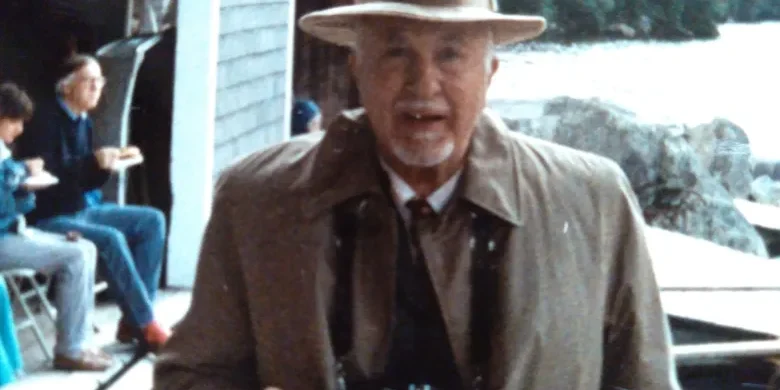
Arthur Crocker: Adirondack environmentalist and peacemaker
Arthur Crocker began a lengthy campaign of protection of the Adirondack Forest Preserve at the Tahawus Club
By Dave Gibson
Tim Rowland’s fine Explorer article Inside the Rich History of the Tahawus Club celebrates the club’s interesting 150-year history in Newcomb, and the strong sense of stewardship felt by the club’s present leadership and membership. Some members have influenced events beyond, even far beyond the club and its environs. One such is club member and renowned American diplomat, Chester Crocker. I would like to focus this post on Chester’s late father, club member Arthur Crocker, because Arthur was a particularly influential and farseeing environmentalist.
I was fortunate to know Arthur Masten Crocker within the ranks of the Association for the Protection of the Adirondacks, where he was president, chair, and honorary chair, and I was the group’s executive director. In 1998, we presented Arthur with our most prestigious award at the Tahawus Club.
I have a thick file of Arthur letters, but the very last letter I had from him was in 2004 in which he wrote: “I submit the opinion that, according to the decision of the Appellate Division of State Supreme Court and the Court of Appeals in the case of McDonald v. the Association for the Protection of the Adirondacks (the 1930 forever wild case), cutting trees to provide trails for snowmobiles or roads for all terrain vehicles is unconstitutional.”
Even at 95 years, Arthur was not about to cease thinking, writing and advising not to take our Adirondack Forest Preserve and its constitutional protection for granted.
Arthur’s obituary appeared in the Jan. 13, 2005 edition of the New York Times. He was born in New York City in 1909, graduated from Princeton in 1931 and the Harvard Business School, and served the U.S. as a navy lieutenant on duty during World War II. He wrote that “except for the war years I have visited the Tahawus Club every summer since I was two years old. My first 10 years I stayed with my maternal grandparents, Mr., and Mrs. Arthur Masten. My grandmother was Christine McMartin Masten, a direct descendant of Duncan McMartin, so the Adirondack roots through her are very strong.”
His mentors
Arthur wrote about a lot of formative years spent trout fishing in Henderson Lake and other High Peaks lakes as a youngster and credits many Adirondack guides for helping him land some big ones. An avid outdoorsman and reader, he listed his most influential writings, among them: William Vogt’s “Road to Survival,” 1948; Fairfield Osborn’s “Our Plundered Planet,” 1949, and Samuel Ordway, Jr.’s “Prosperity Beyond Tomorrow,” 1955.
Ordway was also a member of the Tahawus Club. He and another club member, George Brewer, founded the Conservation Fund which later incorporated into the World Wildlife Fund. Both were among Arthur’s mentors.
Warnings from 1963 of global warming and acid rain
Arthur sent me some records of the Conservation Foundation, writing that “enclosed is a report concerning a 1963 conference to discuss possible impacts of carbon dioxide on our oceans and lands which was the first, so far as I know, report about global warming and the effects of acid rain.” Starting in the mid-1950s, Arthur joined the new Nature Conservancy and began to meet leading conservationists of that era.
The Association for the Protection of the Adirondacks
By 1963, Arthur had joined the board of the Association for the Protection of the Adirondacks and was elected president in 1964. He went on to serve the association for 40 years.
His first “challenge,” as he described it, came in the early 1960s when he spoke at one of the country’s first environmental hearings for the group Scenic Hudson to oppose the infamous proposal called the Storm King Mountain Pumped Storage Project. Scenic Hudson won that early and precedent-setting environmental victory on the Hudson River.
In 1964, Arthur led the association’s coalition, along with Paul Schaefer and the Adirondack Mountain Club, opposed to the State Conservation Department’s plan to permit snowmobiles anywhere on the Forest Preserve. The conservation commissioner eventually backed down and authorized snowmobiling only on designated trails.
In 1966, Arthur helped to form the Constitutional Council for the Forest Preserve to assure the integrity of Article XIV during the Constitutional Convention in Albany the following year. In 1967, Arthur and his associates David Newhouse and David Sive succeeded in this goal.
In 1969, important events occurred in Newcomb adjacent to the upper Hudson River. Arthur wrote that “the high point of my career was probably leading an association meeting attended by hundreds in the public school at Newcomb to protest the planned Gooley Dam on the Upper Hudson which would have flooded most of the village of Newcomb, and much of the Goodnow Flow and Essex Chain of Lakes.” Gooley Dam was never built (for more on this topic see my 2025 book “A Force for Nature: Paul Schaefer’s Adirondack Coalitions”).
Acid rain
Arthur’s awareness of the impacts of acid rain on his beloved Adirondack lakes and streams dated to the 1950s, decades before it came to public attention. In a short biography, Arthur wrote that “I made a little noise on the subject.” Indeed, he did. No one did more to inform the public about the changes to soil and water chemistry caused by acid rain and its cascading effects on Adirondack freshwater than Arthur. His pamphlet on this topic was published by the association in 1979. He organized an Adirondack conference on acid rain and was pleased to support the efforts of Keene resident Dan Plumley and others to, through their advocacy, force the steep declines in sulfur dioxide emissions from Midwest utilities we now enjoy through an enforceable 1990 provision of the federal Clean Air Act. U.S. congressional members and president George H. W. Bush were recipients of many Crocker entreaties to control acid rain causing emissions. Once more, on a pressing national as well as Adirondack issue, Arthur succeeded through steady education and applied pressure.
The APA
In 1968, Arthur was named an advisor to the Temporary Study Commission on the Future of the Adirondacks by Gov. Nelson Rockefeller. As such, he came to firmly believe in the need for the Adirondack Park Agency. The inception of the APA (1971) and its Private Land Use and Development Plan of 1973 came about with Crocker’s strong backing.
Arthur wrote me in 2003 that “because tourists, recreationists and summer visitors do not vote in Adirondack elections, we must continue to make the APA what Bob Flacke, former mayor of Lake George, former APA chair and former DEC commissioner had hoped: a forum for decision-making in the Adirondacks. It is only through a strong APA working with a dedicated DEC that we can take care of the Forest Preserve as planned. That means keeping up the pressure on air pollution and controlling motorized equipment. We need to be an example of wilderness protection to the rest of the U.S., if not the world.”
Arthur dreamed of fostering Adirondack peace and consensus-building in the Adirondacks and among its residents and visitors. Those goals were why, in 1977, he instituted yearly issue conferences and forums sponsored by the Association for the Protection of the Adirondacks.
He and Newcomb Supervisor George Canon got to know each other through fishing together. In 1995, Arthur expressed to George his hope that together they could encourage the APA to become more of a forum for thoughtful policy proposals and decision-making.
Peacemaker
I close with his letter from 1993 in which Arthur wrote: “It is my belief that the time has come to think about peace in the strife between Adirondack residents and the various other interests, namely the timber companies, seasonal residents and users of the Forest Preserve. I believe the time is nearly ripe to seek a peacemaker organization.”
Arthur was a foremost thinker about the Adirondacks and our small, fragile home, the earth. He was his own peacemaker organization. No one who knew him could see him as one dimensional. An intellectual, he also had a deeply spiritual nature, as well as a practical side when it came to building consensus around Adirondack policy. Throughout his life, Arthur retained several thoughts in his head at one time and took counsel widely from those he sought and respected, be they a local supervisor, fishing guide, writer or legislator.
His son Chester became American assistant secretary of state for African affairs, frequently seeking pathways to a more peaceful world through negotiation among other nations and peoples.
For Arthur, it all began at the Tahawus Club and the surrounding High Peaks. As he wrote, “because I had fished in Colden and the Flowed Lands beginning in 1917, I was motivated to become involved in efforts to curtail the emissions that caused acid rain.”
For Arthur Crocker, the economic and ecological futures of the Adirondack Park boiled down to his understanding that “the Greek word ‘Oikos’ is the root for both our words ‘economics’ and ‘ecology.’ ‘Oikos’ means ‘house,’ or ‘home.’”