


Cabin Fever & Adirondack Storytelling
By Dave Gibson
As big game season and Veterans’ Day align, I tend to think of my friend, the late Don Brightman, who died in 2019. Don, a resident of Burnt Hills, was a founding board member of Adirondack Wild: Friends of the Forest Preserve. Don visited, fished, hunted, rowed, camped, and canoed the Adirondacks regularly, alone, and with members of his family.
Some of those visits were to an Adirondack cabin, “Beaver House,” named by the man who built the cabin, someone Don knew well, Paul Schaefer.
In building the cabin, Schaefer named it Beaver House because when sanding the big center-beam he thought it smelled of beavers. That made complete sense to him because the beam came from an old Dutch building from the early 18th century then (1960) being torn down just south of the city of Albany.
November is the time of year Don enjoyed still hunting for white-tailed deer when, in his words, he was often “skunked.” As for Veterans’ Day, I suspect not a day went by throughout the year when his memories were not peopled with comrades from World War II. I only suspect this because he freely shared some of his memories at the cabin.
After Paul Schaefer died in 1996, friends of Paul – like Don – by dint of their interest in the cabin, its landscape, and its friends not only visited but worked on the place and kept it looking much better than it otherwise would have.
Once the mowing or bushwhacking or firewood or clean-up of the cabin was done, or even if it wasn’t, many pleasant hours were spent in friendly conversation. Don was a particularly fine story- teller.
My friends and I recall sitting in the cabin’s kitchen when Don talked about his comrade serving with him in Europe during World War II. They survived the War and their friendship also survived throughout their lives to come.
I sat amazed as Don spoke of his friend, the War, including the boredom and just some of the crazy situations they got into when bored, as well as the fear and reacting to intense German fire.
Don’s army unit finally arrived at the Rhine River in early 1945 and they all had to cross that broad river under fire. Many men around him did not know how to swim, row or paddle a boat.
Many of them were killed or wounded as a result of fearful floundering in the Rhine, he told us.
Don had grown up feeling comfortable on the water, swimming, sailing, canoeing, and fishing from small craft. Twenty years later, in 1964, he nearly qualified as an Olympic canoeist. He participated in the North Creek Canoe/Kayak races on the Hudson, known as the Hudson River Derby.
He said that on the Rhine River in 1945 the one thing he did not fear was that broad stretch of water. He took over his boat, grabbed the oars, and steered it as efficiently as he could across the Rhine as bullets whizzed by him and his comrades in arms. Death was all around him. He just kept rowing.
Aside from learning about some of his war experiences, there was also ample cabin time for quiet contemplation of the mountain valley beyond the cabin, of the birds and insects, the wind, a gust here or there, a rain cloud, an enormous cumulous cloud or a sunset firing over the mountain, or the patter of a steady rainfall, the sounds of a gale or snowstorm blanketing all creation.
And before departing that or the next day, one hard and fast rule of the cabin was, and still is to always write in the logbook. Don never forgot that rule and wrote what I consider some of the best entries any human on earth could write in such a place. Here are a few samples of Don’s many cabin logbook entries over the years:
Feb 24 2001 – “Just read again the words in the earlier part of this book. I do it now and then. As usual my eyes mist up when I see laid out something of the souls of the people I have come to love. This place has a magic quality about it that brings on a spell, part Paul, part Adirondacks, part wood smoke, part snow flakes, part quietude and not least, part my knowing that the same mystique touches us all. It must not be lost, ever.
“The day has been one of those days that only Robert Service could properly describe; blazing sun, temperature 30 deg. F and hard snow with 2 in. of powder topping, dry air, no wind – God! Couldn’t get the rest of my crew to sign in.
“Nobody follows my orders any more. Did they ever? Tried out my new false knee at Gore ski hill yesterday. Not as good as I had hoped, but far better than watching the boob tube. Thanks, Beaver House gang for letting us use this great treasure as though it was our own.”
Oct 26 2009 – “Came to the base for a foray for white tailed deer which, I was advised, overrun the environs. A friend and I scoured the woods and managed to see nothing but Eleventh Mt. silhouetted through the tops. Skunked as usual.
“Reveled in the cozy space of the BH [Beaver House] kitchen into the evening while my legs recovered some of their vigor. The only game visible are the flies which come from hibernation when heat arrives. No fly recipe available so we’ll leave them to their torpor when cold arrives. Thanks again BH gang for your friendly gift of allowing me to use
this great place.”
During the 1960s the upper Hudson River was threatened with five dams stretching from the Blue Ledges in Indian Lake, south to Luzerne. This was another time of emergency for Don, when this wild river that he came to know so well would have been completely tamed, flooding north 25 miles all the way to Newcomb.
Don was outraged at the prospect of taming this great, wild river. Despite full-time employment with the General Electric Co. and family responsibilities, Don stepped forward to accept Paul Schaefer’s appointment as the voluntary executive secretary of Schaefer’s Adirondack Hudson River Association.
The Association’s purpose was to fight these dams with every ounce of their collective strength.
From 1965-69, Don Brightman, an expert whitewater canoeist, met monthly with others to strategize at Schaefer’s house. Don kept detailed, hand-written records of their decisions, maintained correspondence with hundreds of people from all across the state, and testified at Congressional hearings about state and national river protection.
Among his correspondents was New York’s U.S. Senator Robert F. Kennedy, whom Brightman hoped would sponsor the
nation’s Wild, Scenic and Recreational Rivers Act of 1968. Kennedy did.
In 1969, pushed by Schaefer’s Adirondack Hudson River Association and Don Brightman’s role, the state legislature passed and Governor Nelson Rockefeller signed legislation prohibiting dams on the Hudson River above Lake Luzerne.
Even with these threats to the upper Hudson River averted, Don kept going. He went on to help Schaefer and company to influence enactment of New York’s Wild, Scenic, and Recreational Rivers (W/S/R) Act of 1972.
One way Don helped was to appear in Schaefer’s film Of Rivers and Men, directed by Fred Sullivan. Don can be seen canoeing the Hudson below its confluence with the Indian River. You can watch the film here.
Schaefer told us that the film was shown to Governor Nelson Rockefeller’s new Department of Environmental Conservation; subsequently, DEC Commissioner Henry Diamond employed the film to help persuade a reluctant Governor Rockefeller to sign the W/S/R Rivers legislation.
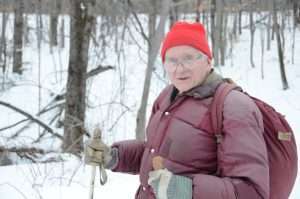
Photos, from above: Don Brightman writes in the Beaver House log, Dec. 2015; and Brightman in the woods.