

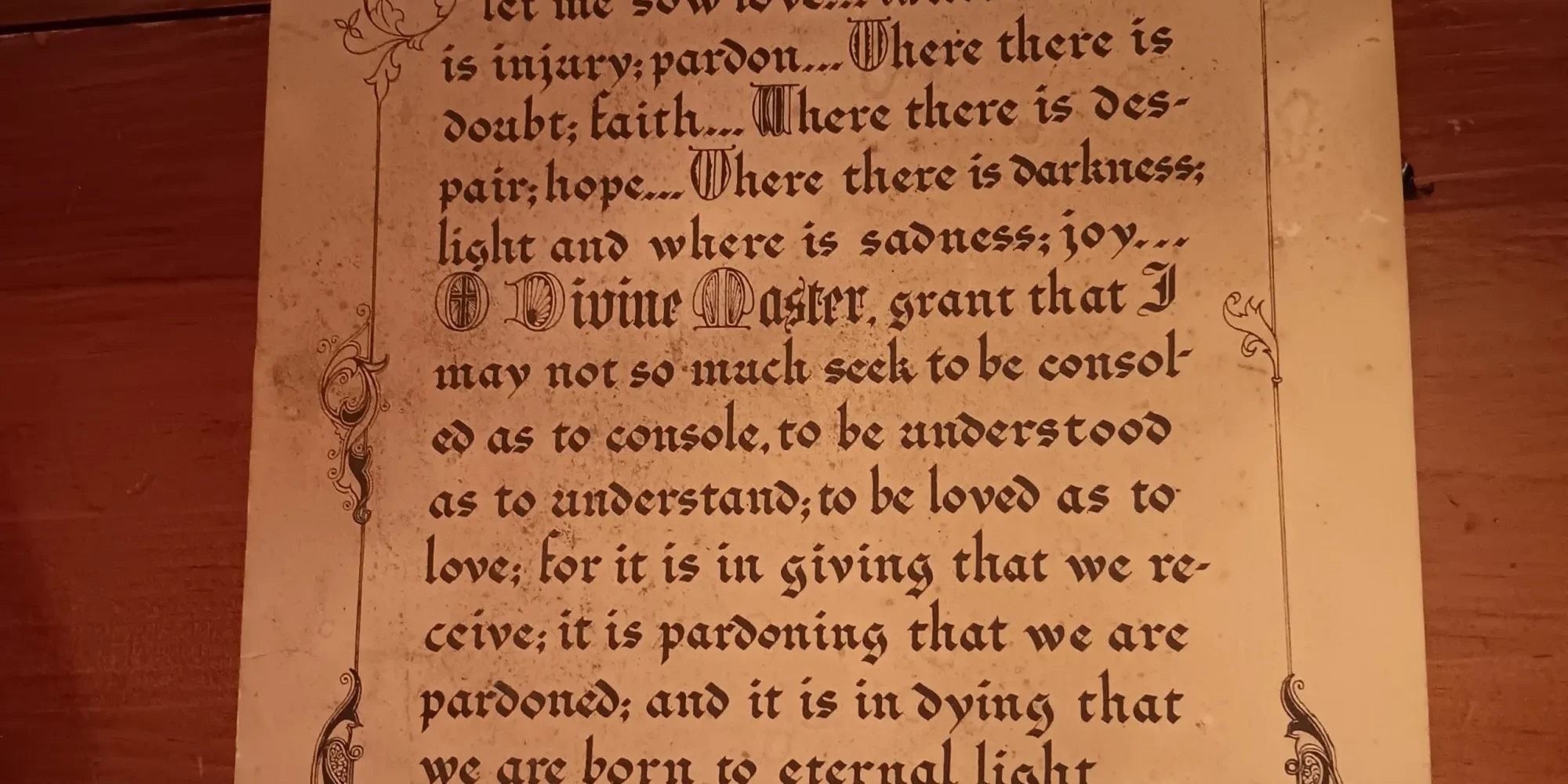
Francis’ peace prayer: A gift from Paul Schaefer
Famed Adirondack wilderness conservationist Paul Schaefer gifted many prints of Saint Francis’ peace prayer during his life
By Dave Gibson
The Cathedral of St. John the Divine in New York City reminds me that on this Oct. 4, the Feast Day of St. Francis, the world commemorated 800 years since the saint’s death in 1226. Every day I pass our living room where, prominently framed on our wall, is a copy of the saint’s peace prayer. This version of Francis’ peace prayer was printed in calligraphy and gifted to many by Adirondack wilderness conservationist Paul Schaefer.
Eight hundred years on, the prayer and Francis’ ethical concerns for all life are just as meaningful today as then, perhaps more so. Schaefer (1908-1996) certainly thought so, or he would not have sought out a calligrapher, Louis DiGesare, of Scotia, to produce this beautiful version of the prayer and print it, suitable for framing, in quantity to give away to anyone Schaefer felt might appreciate it.
Working with his hands to construct fine and practical human shelters, Schaefer believed that spirit inhabited every building, all of us, all creatures, the world, sunsets, sunrises, woods, waters and wildlife included. All are capable instruments of granting and receiving the Lord’s peace. Inside every cover of every book in his extensive Adirondack library (Schaefer was a voracious reader and helped launch the Adirondack Research Library at Union College in 1979), Schaefer glued a bookmark quoting Shakespeare: “Find sermons in stone, tongues in trees, books in the running brooks and good in everything.”
Schaefer and his family grew up through the Great Depression and World War II. He faced many personal, financial, professional and environmental challenges. For nearly 70 years, Schaefer fought dam builders and all who would compromise the state constitution’s forever wild protections by trivializing and commercializing Adirondack, Catskill and national wilderness values. He also found time for his home construction businesses, employees, his wife Carolyn, and their four children. Sometimes feeling alone and vulnerable, Francis’ peace prayer may have consoled and inspired him. So, in giving away the prayer, he received, in turn.
In his adult years, Schaefer wrote three books about his Adirondack adventures, about the hundreds of battles he fought defending the wilderness of the Adirondack and Catskill Forest Preserve, and about the people who inspired him. Thinking about writing a biography of Schaefer, I was interested in his earlier writing. Out of the blue came a mailing from his sister, Gertrude Fogarty. Inside was this letter addressed to me:
“While going through some of my treasures recently I came upon the enclosed little story that Paul wrote when he was 16 (1924). I don’t think anyone outside of the family is aware of this, but somehow it was given to me, and I thought you would appreciate it. He must have written it about the time when we all were discovering the joy of mountain climbing,” Fogarty wrote, who, in 1931, climbed Marcy, Skylight and other peaks, and hiked into Panther Gorge with two other young women.
In Fogarty’s enclosure were her brother’s feelings of being in the Adirondack mountains. Titled “The Lone Sagamore, or The Spirit of the Dawn,” Schaefer’s early Adirondack writing captures his excitement at not only being in the wilderness, but fully present with its entire community of life. Reading this provides insight into why as a grown man he gave away many copies, in wondrous calligraphy, of Francis’ peace prayer.
“With a final burst of exertion that set my heart racing, I climbed over the topmost ledge of Gore Mountain and stood in silent awe upon its rocky windswept pinnacle,” Schaefer wrote in “The Spirit of the Dawn,” in 1924 (unpublished). “Completely forgotten now were those long hours of struggle up precipitous cliffs and ledges under the starlit heavens of that early September morn, and now as a crisp breeze from the West fanned my cheek I knew a thrill as indescribable as the phantom of the camp fire!”

“To the north, to the east, to the south and to the west, the vast Adirondack wilderness lay stretched at my feet, ending only when mighty ranges rose up to form the horizon with the blue-gray sky, scores of miles away,” Schaefer continued. “As silently as they had come ,the stars were now leaving their guard, for the veil of night had faded and a new dawn was about to break. Far in the east, where a spruce clad mountain stood in silent majesty, a faint rosy glow appeared, sharply contrasting the hazy outlines of the other mountains. The bewitching fragrance of pine, balsam and spruce lay heavily on the crisp air, while overhead, floating placidly, the distant cloud forms drifted like mammoth icebergs in the sea…Oh! The bewildering sense of exultation one feels, when alone he has conquered some wild, rugged peak, and alone sees the glory of the wilderness below him: Here a lake of azure, there a silver river threading its way through a pine clad valley.”
My biography of Paul Schaefer, “A Force for Nature: Paul Schaefer’s Adirondack Coalitions,” is available from Syracuse University Press or from your local bookstore.