


Keeping the Wild in Wilderness
By Chad P. Dawson
Dec. 11, 2025
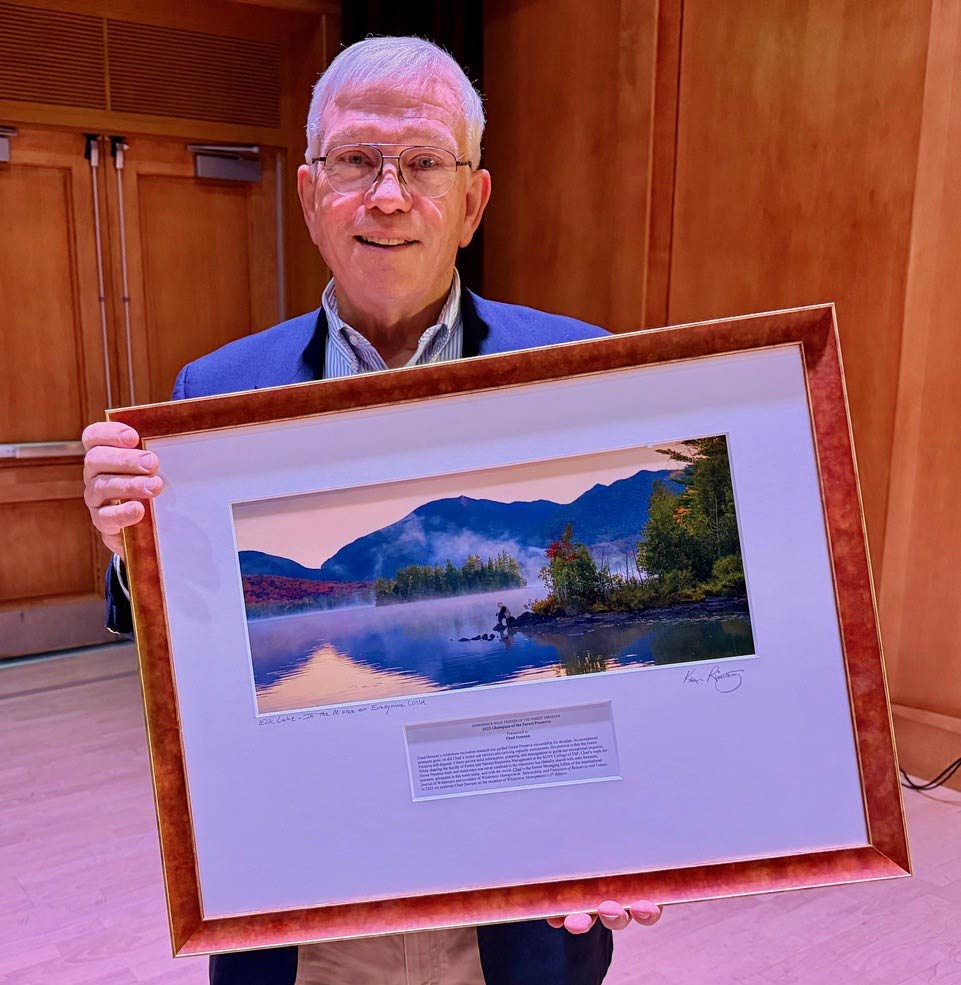
Wilderness recreation management professor emeritus, and former Adirondack Park Agency member Dr. Chad P. Dawson came to Adirondack Wild’s 2025 Annual Members Meeting in Old Forge to present “Keeping the Wild in Wilderness,” a review of his text Wilderness Management: Stewardship and Protection of Resources and Values (5th Edition, 2025) and his perspective on the state of the nation’s Wilderness system since enactment of the 1964 National Wilderness Act. Read his thought-provoking slide presentation.
To read more about his presentation:
The National Wilderness Act and the Adirondack and Catskill Park State Land Master Plans state that “a wilderness, in contrast with those areas where man and his own works dominate the landscape, is hereby recognized as an area where the earth and its community of life are untrammeled by man, where man himself is a visitor who does not remain.”
Untrammeled means unconfined, unhobbled, unmanipulated, free to be itself. Wilderness is further defined as “an area of undeveloped land retaining its primeval character and influence, without permanent improvements or human habitation, which is protected and managed so as to preserve its natural conditions and which generally appears to have been affected primarily by the forces of nature, with the imprint of man’s work substantially unnoticeable.”
However, as the climate changes dramatically the historic range of “natural conditions” has also abruptly changed. As a result, when wetlands dry up, when native forests die from beetle infestations or burn, or when pollinating insects disappear from otherwise wild areas, should our wilderness land managers seek to “restore” former, natural conditions by building roads, setting prescribed fires with mechanized equipment, replanting species adapted to warmer climates using bulldozers, or use helicopters to restock fish that may have once swam in those waters?
On popular hiking trails within Adirondack Wilderness, more intense rainfall has contributed to trail erosion. Will hardening of those trails using engineered, heavy, split stone steps conflict with the primary Wilderness guideline “to achieve and perpetuate a natural plant and animal community where human influence is not apparent”?
Do the very “restoration” tools employed to “restore” conditions also severely manipulate the Wilderness, destroying its primeval character, and therefore violate the Wilderness definition?
These tensions are extensively treated in the 5th edition of the classic text Wilderness Management: Stewardship and Protection of Resources and Values. WM’s editor Chad P. Dawson, SUNY ESF professor emeritus of wilderness recreation management, was in Old Forge on October 10 2025 to present to Adirondack Wild’s members his thought provoking review of WM 5th Edition, how far the Wilderness system nationwide has come since 1964, how it has grown, but also how climate change presents increasingly perplexing and controversial Wilderness stewardship choices for land management agencies, including our NYS Department of Environmental Conservation, DEC, and Adirondack Park Agency, APA.
As Chad and WM 5th Edition lay out alternatives, should Wilderness managers accept changed natural conditions and allow natural processes to continue even while conditions are transformed, while maintaining human restraint? Or should they direct landscape change by actively planning and guiding ecosystem changes toward a preferred former condition – even if in doing so they use machines and risk manipulating and trammeling Wilderness character?
Enjoy Chad Dawson’s important and thought-provoking slide presentation, “Keeping the Wild in Wilderness.”